Frank Costello Net Worth: Prime Minister of Underworld’s Fortune Then and Now
Frank Costello’s wealth has been argued about for decades, which is why “frank costello net worth” remains a popular search even long after his death. The short answer is that no official, audited number exists, but historians and modern net worth trackers generally place his fortune in the high nine figures when adjusted for today’s dollars. Costello made money the way powerful mob bosses did in his era—through gambling, political influence, and “legitimate” fronts that helped cash flow look clean on paper.
Quick Facts
- Full name: Francesco “Frank” Costello (born Francesco Castiglia)
- Born: January 26, 1891
- Died: February 18, 1973
- Age at death: 82
- Birthplace: Calabria, Italy
- Known as: “The Prime Minister of the Underworld”
- Crime family: Luciano family (later known as the Genovese family)
- Spouse: Loretta “Bobbie” Geigerman (married 1914)
- Children: None (widely reported)
- Estimated net worth: About $150 million at death (estimate), roughly $1 billion+ in today’s dollars (inflation-adjusted estimate)
Frank Costello Bio
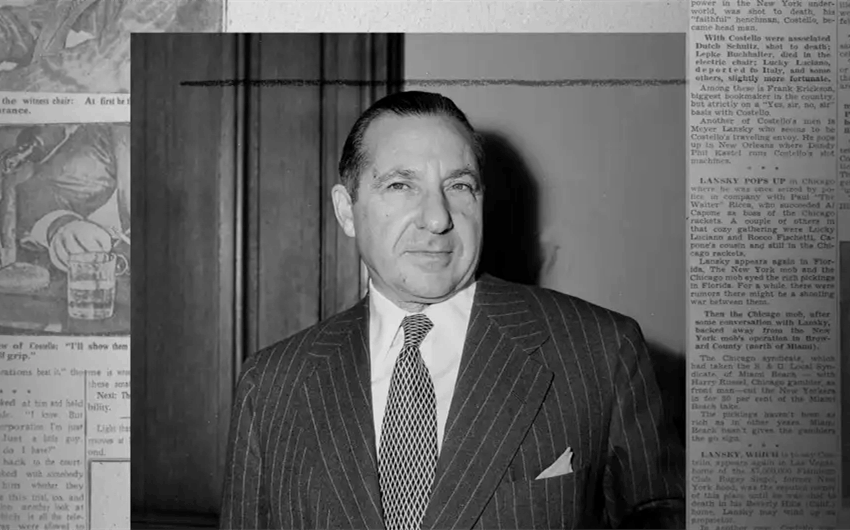
Frank Costello was one of the most influential American mob figures of the 20th century, known less for street violence and more for strategy, alliances, and political connections. He rose during the Prohibition era, partnered with major names in organized crime, and eventually became a dominant power broker inside the Luciano organization. Costello’s reputation came from his ability to earn quietly, keep politicians and businessmen close, and survive storms that ended other bosses—investigations, prison time, and even an assassination attempt.
Loretta “Bobbie” Geigerman Bio
Loretta “Bobbie” Geigerman was Frank Costello’s wife and longtime private partner in life. While Costello became famous for influence and wealth, Loretta stayed out of the spotlight, rarely appearing in public narratives beyond photographs and a few accounts of their domestic life. Their marriage is commonly described as stable and discreet, and most biographies note they did not have children. In a world built on attention and fear, Loretta’s public invisibility was part of the story.
Frank Costello Net Worth
Frank Costello’s net worth is most commonly estimated at around $150 million at the time of his death in 1973, with an inflation-adjusted equivalent that can land around $1 billion or more in modern dollars. The range exists because Costello’s wealth was never meant to be neatly documented. He operated in an era when cash businesses, hidden ownership, and proxy names were standard tools, and when even “legitimate” assets could be tied to behind-the-scenes arrangements.
There’s also a second reason estimates vary: people often confuse the earning power of an entire crime organization with one man’s personal balance sheet. Costello influenced a massive gambling ecosystem, but influence is not the same thing as direct ownership. His fortune likely included a combination of cash, real estate, business stakes, and ongoing profit participation—exactly the kind of assets that are difficult to count from the outside.
How Costello Built His Fortune
1) Gambling and the “Quiet Money” Machine
If you want to understand Costello’s wealth, start with gambling. Gambling is steady. It’s cash-heavy. It doesn’t rely on one lucky score. It also scales fast when you control territory and have protection from law enforcement pressure. Costello was known for having a deep hold on gambling revenue streams, including bookmaking and numbers operations, and he benefited from an era when organized gambling could be moved, hidden, and rebuilt quickly after raids.
Gambling wealth also has a special advantage: it can be split into smaller flows that look like normal “business income” when routed through the right fronts. Even if a boss doesn’t own every operation directly, a network of tribute payments and partnerships can produce consistent, large income.
2) Slot Machines and Vending-Style Rackets
Costello’s name is repeatedly connected to slot machine and vending-style rackets—one of the smartest long-term plays mob leadership ever found. Slot machines generate daily cash, and they can be placed across wide areas through relationships with bars, clubs, and distributors. This kind of operation doesn’t look like a dramatic movie heist, but it can be brutally profitable.
What made these rackets so valuable is that they blended “business logistics” with underworld enforcement. If you controlled placement, maintenance, collections, and protection, you could build an income stream that kept paying even when other rackets cooled off.
3) Political Influence as a Profit Multiplier
Costello was famous for influence with politicians and power brokers, and that mattered because influence reduces risk. When law enforcement pressure drops or court outcomes soften, the business runs longer and smoother. That translates into wealth.
Political connections also open doors to permits, property deals, and “friendly” oversight—advantages that can turn borderline businesses into stable assets. Costello’s style was often described as less about terror and more about relationships, and that approach tends to build larger fortunes over time because it avoids the constant disruption that violence brings.
4) Legitimate Fronts and Real Estate
Most top-tier mob fortunes were not stored as a mountain of cash under the bed. A smart boss spreads money across assets that hold value: real estate, business stakes, and investments that can be explained in public. While the details of Costello’s holdings aren’t fully transparent, it’s widely understood that organized crime leaders of his level used legitimate fronts to stabilize wealth and reduce exposure.
Real estate, in particular, is a classic move. Property can be held quietly, it can appreciate, and it can also serve as a place to park money while producing rental income that looks respectable. Even one or two premium properties can represent enormous long-term value, especially if bought early and held for decades.
Why He Never Gave a Clean Number
Costello famously resisted questions about his finances during major public investigations. That wasn’t just stubbornness—it was strategy. In his world, admitting wealth created legal problems, tax problems, and political problems all at once. The more clearly you describe your fortune, the easier it is for the government to challenge how you got it.
And that leads to an uncomfortable truth about net worth estimates for figures like Costello: the best clues often come from what he refused to answer, what prosecutors tried to prove, and what investigators suspected based on lifestyle and associations. It’s not a standard “salary plus investments” story. It’s an intentional fog.
How Big Was His Fortune Compared to Other Mob Bosses?
Costello is typically ranked among the wealthier and more influential bosses of his era, especially because he focused on high-cash, high-scale rackets that could run for years. Some bosses built reputations through violence and fear, but fear burns hot and attracts attention. Costello’s method—earning power, business-like operations, and political insulation—was better suited for building lasting wealth.
That’s why many estimates land so high when adjusted for inflation. Even if you discount the most extreme numbers, the core idea remains: Costello’s fortune was significant enough to remain famous decades later, and large enough that investigators and lawmakers treated him as a national symbol of organized crime money.
What the Best “Working Estimate” Looks Like
If you want a practical takeaway for frank costello net worth, this is the most reasonable way to frame it:
- Estimated at death (1973): roughly $150 million (estimate)
- Inflation-adjusted modern equivalent: roughly $1 billion+ (estimate)
- Most credible explanation: gambling-driven cash flow, slot machine revenue, influence-based protection, and assets held through fronts
Could it have been higher? Possibly, depending on hidden ownership and how you count organization-wide profit participation. Could it have been lower? Also possible, if you assume more of the money belonged to partners and networks rather than Costello personally. But the general consensus is clear: he died extraordinarily wealthy by the standards of his time.
Conclusion
Frank costello net worth is best understood as a blend of documented estimates and informed inference. A common estimate places him at about $150 million when he died in 1973, which becomes around $1 billion or more in today’s dollars after inflation. He built that fortune through gambling, slot-machine style cash businesses, political influence, and wealth storage methods that were designed to stay hard to trace. Whether you see him as a ruthless criminal or a skilled operator, his financial legacy is the same: he mastered the most profitable rackets of his era and turned them into a fortune that still gets searched today.
image source: https://nation.foxnews.com/geo-block